
Total Performance
The Science of
Playing Better & Longer
Delivered by an entire portfolio of patented innovations for cleated footwear, which enhance athletic performance while lowering non-contact injury potential.
Allowing the Body to Work as Designed Represents the Real Breakthrough.
Looking at cleats simply as gripping technology misses how they can both improve performance and reduce injury risk.
Our background is in the esoteric field of in-shoe pressure analysis. We studied weight distribution in shoes to solve the age-old dilemma of high-heeled shoe pain, and we’ve sold over 30,000,000 pairs of high-heeled shoe components worldwide.
Watching a rash of game-changing injuries led us to study how cleats disrupt the transfer of weight, thereby reducing power utilization and inhibiting protective motion mechanisms.
By Solving the Weight Flow Issue, We Solved Multiple Problems Simultaneously.
What was missed was the duality of performance and safety because they happened inside the shoe.
Out of Sight, Out of Mind.
In-shoe pressure analysis opened the world of motion enhancement by watching how the foot reacted to cleat location and design.
What Is Total Performance?
Total Game Performance
Enhanced metabolic efficiency
Means sustained high-level play through the full 90 minutes of a soccer game.
Improved linear acceleration from proper forefoot mechanics.
Faster directional changes from reduced rotational resistance.
Total Career Performance
Protective forward weight shift during deceleration
Reduces biomechanical risk factors associated with non-contact injuries
ACL injuries
Achilles injuries
Lateral ankle sprains
Turf toe
The Insolia Cleat Delivers Both through the Same Biomechanical Mechanism
By restoring natural foot mechanics that conventional outsole designs restrict:
The IMS Cleat Reduces Energy Expenditure, and
Moves the Athlete into a Protective Position.
Total Game Performance and
Total Career Performance
Are Not Separate Goals.
They are Two Outcomes of the Same Solution!
Total Game Performance
— The Evidence
Current Boot Engineering Borrows the Carbon-Plate Stiffness Paradigm From Track Shoes:
Stiffer Outsoles Produce Better Sprint Metrics Over Short Distances.
But Soccer Is Not a Sprint
It Is 90 Minutes of Intermittent High-Intensity Effort.
The IMS Cleat Is Designed for the Demands of a Full Match,
Where Metabolic Efficiency and Sustained Output Determine the Outcome.
Improved Metabolic Efficiency
Reduced VO₂/kg by 10%
9% lower heart rate
3.6% fewer steps per distance.
These efficiencies compound over 90 minutes.
Athletes using conventional boots spend measurably more energy with every step.
Independently tested and reported University of Wales,
23% Less Rotational Torque
Faster directional changes with reduced knee stress.
The Insolia Radial Stud Array enables quicker turning without sacrificing straight-line traction.
Tested at MIT
Linear Traction Maintained
No sacrifice in straight-line speed or acceleration.
The IMS Cleat matches conventional designs in linear traction while fundamentally improving rotational mechanics.
Tested at MIT
Mechanism of Non-Contact ACL Injury
Barry P. Boden, MD, Frances T. Sheehan, PhD
The Solution
Forward Weight Shift During Kicking and Deceleration
The IMS Cleat shifts the athlete's center of pressure forward in the planted foot while kicking.
It also shifts weight forward by 5.5%* during the high-risk deceleration phase — a biomechanical position identified as protective.
*Statistically significant (p \< 0.05) · MIT testing, 14 subjects
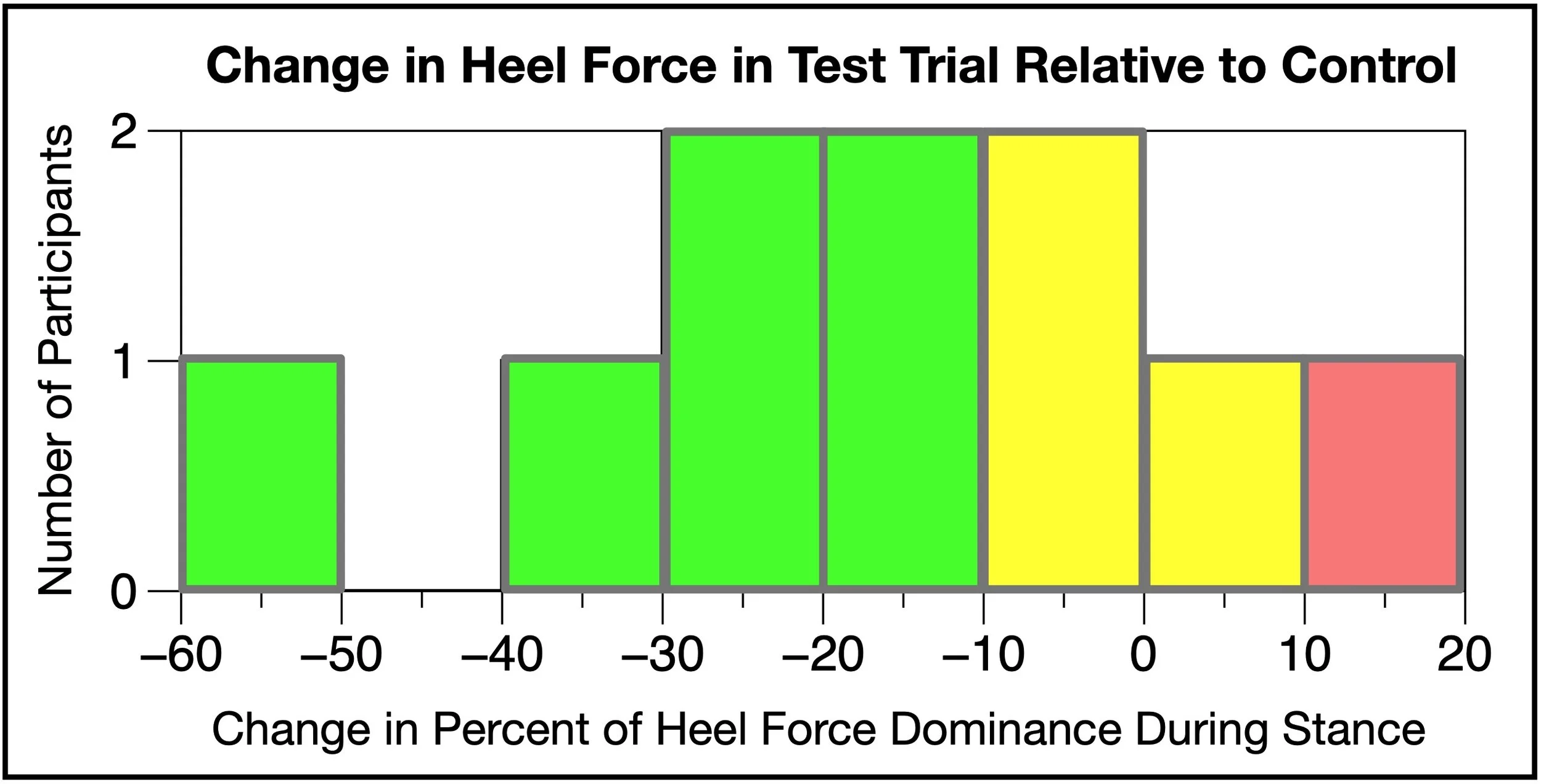
Planted Foot While Kicking Data
Result from 10 Trials
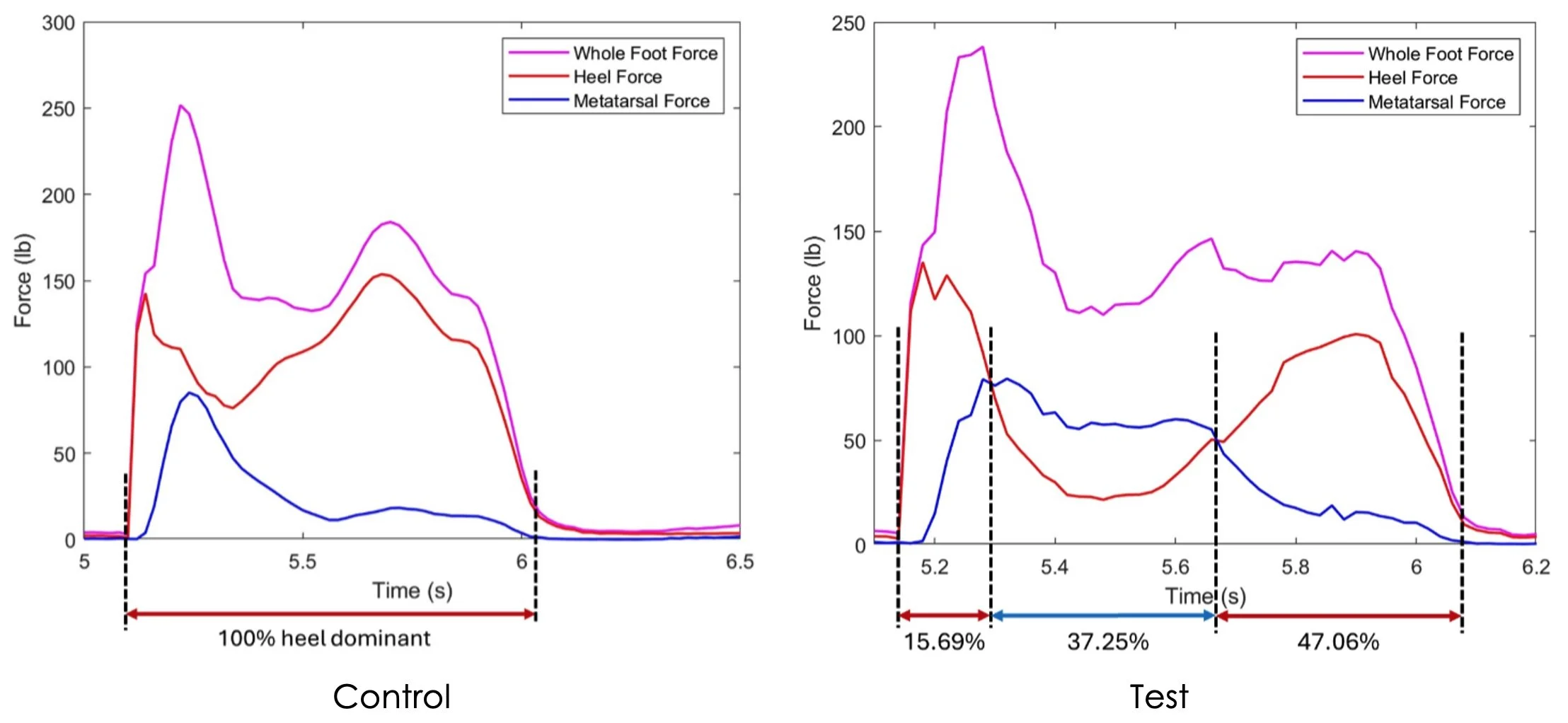
Individual Result
Research identifies forward weight distribution as the safe position
The at-risk position occurs when weight shifts rearward
Insolia IMS elements work together to enhance forward weight shift
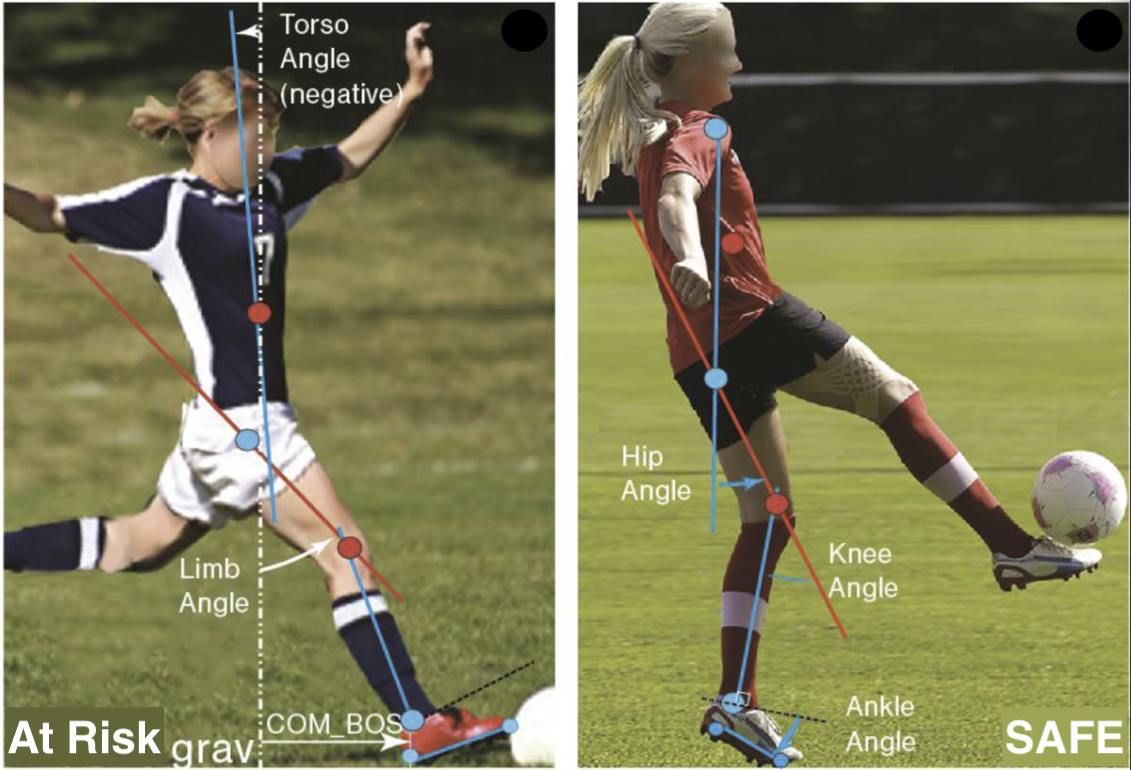
Deceleration Data

Total Career Performance
— The Evidence
When Footwear Restricts Natural Foot Biomechanics,
the Cost Is Paid in Two Currencies:
Energy & Injury Risk
The Same Mechanical Restrictions That Waste Energy
Place Joints in Vulnerable Positions During
Kicking and Deceleration
The Problem
70% of ACL injuries occur without direct contact — typically during rapid deceleration or single-leg landing, when the athlete's weight shifts to the back of the foot.
Female athletes face 2–3× higher ACL injury rates than males.
Why This Discovery Came From
Outside the Industry
The athletic footwear industry designs from the surface up — measuring shoe-to-turf interactions like rotational torque, traction coefficients, and outsole stiffness. These metrics are valuable, but they don't measure what's happening inside the shoe.
HBN Shoe designs from the foot down. Our primary diagnostic instrument has always been in-shoe pressure measurement — understanding where the wearer's weight is, and whether it's in the right place.
That Difference in Methodology is Why
We Saw Something the Industry Hasn't
The Mirror-Image Discovery
We started with footwear's most challenging comfort problem: the high-heeled shoe.
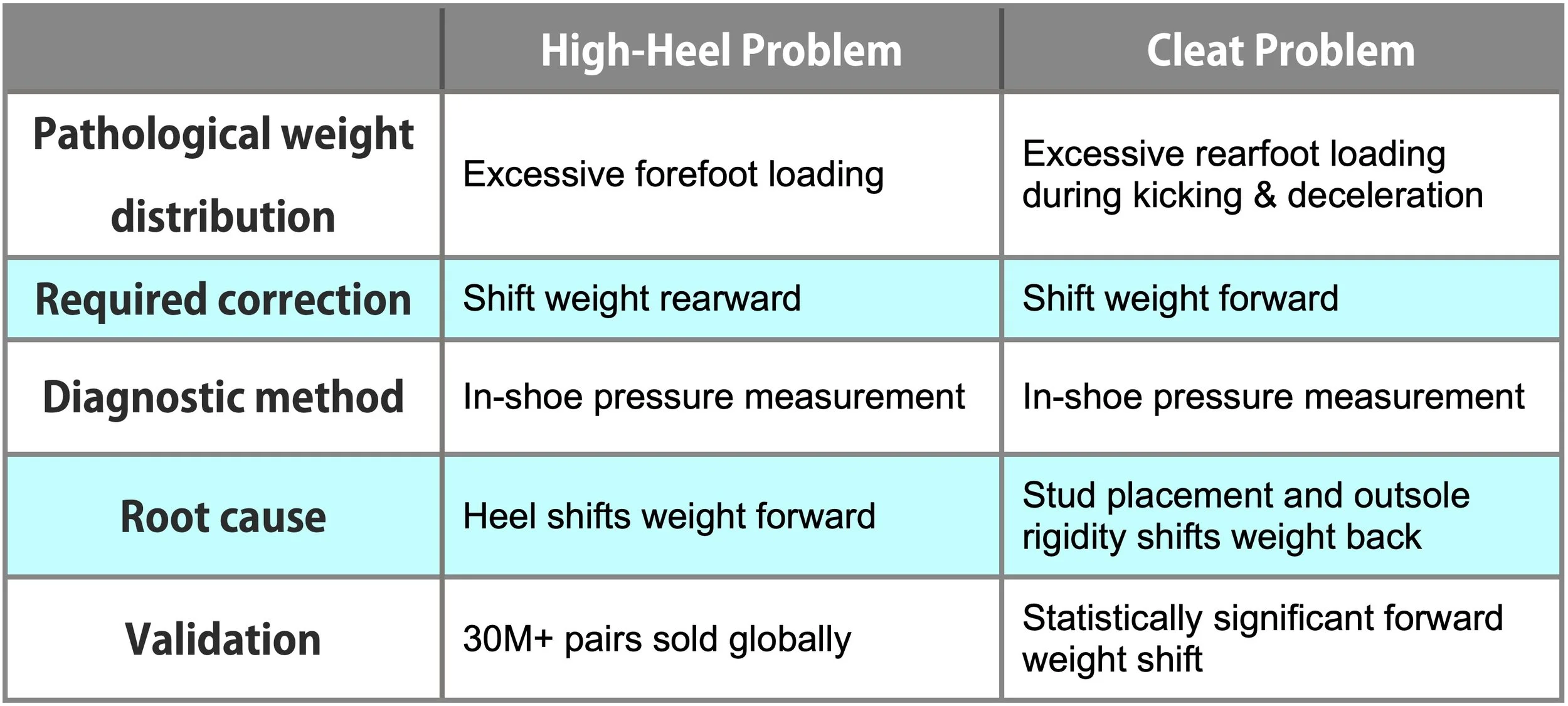
Using in-shoe pressure data, we identified the core issue — a pathological weight shift onto the forefoot caused by heel elevation. Our solution shifted the weight rearward, restoring a healthier pressure distribution.
That technology, Insolia Heels, has been validated in tens of millions of pairs of high-heeled footwear sold globally.
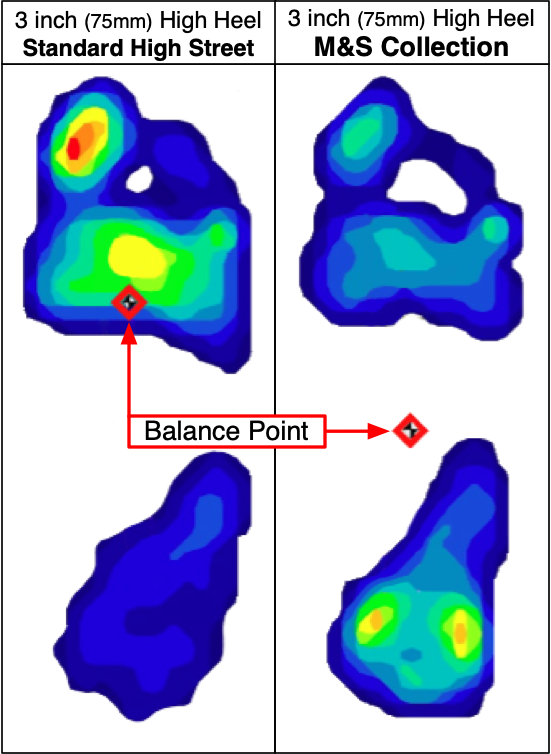
The presure map on the left shows a standard 3 inch high heel pressure map. The pressure on the big toe and ball of foot is clearly visible.
On the right, adding the Insolia High Heel component dramatically shifts weight to the heel, resulting in an instant sense of relief.
When we turned to athletic cleats, we applied the same diagnostic lens
In-shoe pressure measurements during deceleration revealed the mirror image of the high-heel problem:
Excessive rearfoot loading at the moment of greatest injury risk.
The required correction was the reverse:
Shift weight forward onto the forefoot.
Why This Matters
The major athletic footwear manufacturers optimize outsole stiffness, stud geometry, and shoe-to-surface traction.
These measurements are taken from force plates and motion capture systems that operate outside the shoe. They will tell you about rotational torque and linear traction — they won't tell you that your outsole design is putting the athlete's weight in the wrong place at the wrong time.
HBN is the Only Footwear Technology Company That Designs From In-Shoe Pressure Data Downward.
Rather Than From Surface Interaction Data Upward.
That methodological difference is why the IMS Cleat exists, and why it addresses a problem the industry has not yet recognized in its own measurement frameworks.
Insolia Integrated Motion System
Six Patented Technologies Working as
One Integrated System
Removing any single element compromises the system's benefit.
The IMS is licensed as a complete platform.
Boot Technologies
Radial Stud Array™
Studs are arranged in a radial pattern around the foot's natural pivot point.
Creates a single center of rotation aligned with the Great Toe Joint
23% less rotational torque with maintained linear traction.
Zone of Flexibility™
Adaptive hinge molded into the outsole.
Its 3–4 cm length enables proper forefoot bending across the range of foot sizes within each shoe size
A no-moving-parts solution to the bending-point problem.
Insole Technologies
Insolia Flex™
Patented asymmetric depression under the Great Toe Joint.
Facilitates natural:
Great Toe Joint drop & eversion
Ankle flexion
Forward weight shift.
Independently shown to improve metabolic efficiency by 10%.
Free Motion Zone™
Stud-free area beneath the 1st metatarsal head.
Allows natural Great Toe Joint motion during push-off and pivoting by removing the mechanical interference caused by conventional stud placement.
Pressure Relief Dome™
Concave dome creates an air gap, decoupling ground reaction forces from the underside of the Great Toe Joint.
Prevents joint lockup during high-force cutting maneuvers while maintaining outsole structural strength.
Insolia Cradle™
Anatomically-matched heel cup with medial side support.
Contours to the natural shape of the heel bone.
Improves balance
Enhances stability
Reduces plantar fascia strain.
Insolia Sports Technology
Beyond ACL Protection
Our Technology Addresses Four Major Sports Injury Risks:
ACL Tears – through forward weight positioning
Achilles Injury – by enabling natural heel lift
Lateral Ankle Sprains – by controlling foot inversion
Turf Toe – by preventing joint jamming
Each injury stems from restricted Great Toe Joint rotation
When this joint cannot move naturally, the body compensates with motions that increase the risk of injury.
The Core Principle:
Optimizing the Great Toe Joint Function Reduces Injury Potential across All Sports
Next Application:
We are adapting elements of the Insolia Integrated Motion System for all court sports, including basketball, tennis, and pickleball, through specialized insole and outsole designs.
Integrating the Insolia insole innovations into a court shoe that incorporates the Insolia Zone of Flexibility will deliver the same protective forward weight shift demonstrated in our soccer cleat research.
Insolia IMS
Built on Decades of Innovation
HBN Shoe was founded to solve Footwear’s Most Challenging Comfort Problem
High Heeled Shoes
Over 60 million pairs of footwear with Insolia Technologies have been sold globally, delivering measurable improvements in comfort, walking efficiency, and body health.
Learn more about our Fashion & Comfort innovations.